
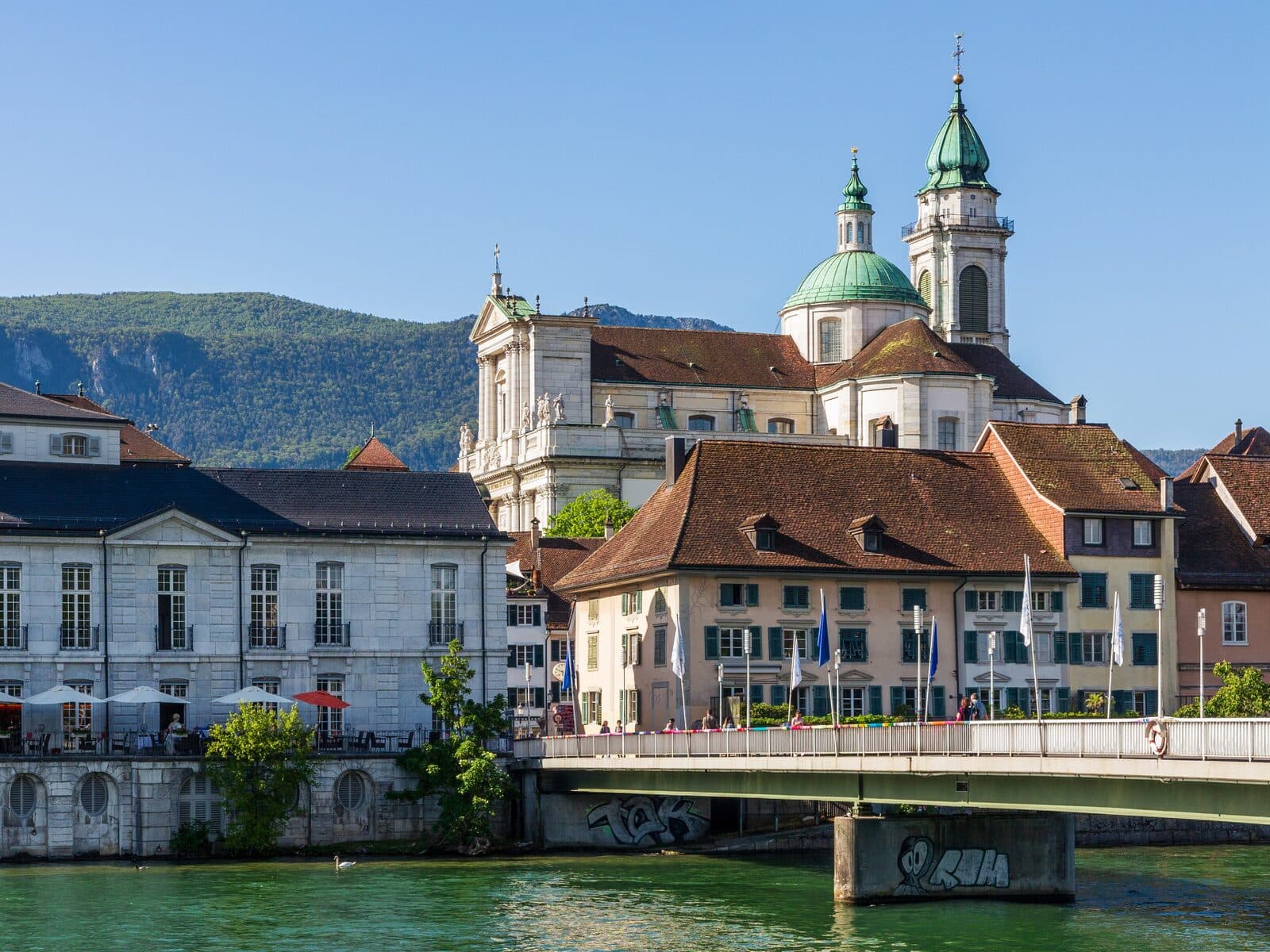
In Solothurn, your residence permit is handled by the Migrationsamt des Kantons Solothurn, the cantonal migration office within the Department of the Interior. It applies the federal rules on permits, language and naturalisation, and proceedings are in German. Your municipality's residents' office is usually your first point of contact and works with the cantonal office.
In short
- Your office: the Migrationsamt. For binding contact details, hours and directions, see https://www.so.ch/verwaltung/departement-des-innern/migrationsamt/
- Language: German. For tests, standard German counts, not the local dialect.
- Processing time: a rough base of around six weeks. Renewals are faster; first permits, C permits and family reunification take longer. These times are not officially confirmed.
- Permits: B, L and C permits follow the federal standard.
- Naturalisation: federal, cantonal and municipal requirements all apply.
About the canton
Solothurn lies in north-western Switzerland at the southern foot of the Jura, with good links to Basel and Bern. Its capital, the city of Solothurn, is known for its baroque old town. Around a quarter of a million people live in the canton, and about a quarter are foreign nationals. For exact figures, see the Federal Statistical Office (FSO) and the cantonal statistical office.
The economy is built on watchmaking and precision industry, pharmaceuticals and medical technology, plus a broad commuter and service economy. This draws EU/EFTA workers under the Agreement on the Free Movement of Persons (AFMP), especially from Germany, Italy and Portugal, and third-country nationals through family reunification, qualified work under Art. 18 of the Federal Act on Foreign Nationals and Integration (FNIA, SR 142.20) and asylum.
B permits are the most common permit among residents. Long-term residents hold C permits, and L permits cover temporary work and students. G permits cover cross-border commuters into the surrounding economic areas, and F, N and S permits relate to asylum. The largest municipalities are usually Solothurn, Olten, Grenchen and Zuchwil.
The law that applies
Solothurn applies federal law first: the FNIA, the Ordinance on Admission, Residence and Gainful Employment (OASA, SR 142.201), the AFMP (SR 0.142.112.681) and its implementing ordinance, the Asylum Act (AsylA, SR 142.31), and SEM practice and directives.
The key FNIA provisions cover work (Art. 18), education (Art. 27), hardship cases (Art. 30 para. 1 let. b), the B permit (Art. 33), the ordinary and early C permit (Art. 34 para. 2 and 4), changing canton (Art. 37), family reunification (Art. 42 to 47), the end of the family unit (Art. 50), integration (Art. 58a and 58b), revocation (Art. 62 and 63) and SEM approval (Art. 99). See the FNIA and OASA glossary, the AFMP glossary and the Asylum Act glossary.
The canton adds implementing law for the FNIA and the AsylA, a cantonal citizenship act and cantonal administrative procedure law. All are in the consolidated collection of laws of the canton (Bereinigte Gesetzessammlung, BGS).
Contacting the Migrationsamt
The Migrationsamt handles permits, renewals, changes of status, family reunification, settlement permits and the coordination of naturalisation. Its address, phone, email, hours and directions change, so use the official page above or the cantonal portal https://www.so.ch. Check there too whether you can apply or complete steps online.
Your municipality of residence (the residents' office) registers you, handles residence matters and does first checks. Find its contact details on your municipality's website.
Processing times
These are rough estimates only, not official figures. The real time depends on your file, the completeness of your documents, the workload and your case.
| Procedure | Estimated time |
|---|---|
| B permit renewal | about 3 to 6 weeks |
| First B permit (family reunification, work) | about 6 to 12 weeks |
| L short-term permit | about 4 to 8 weeks |
| Ordinary C permit (after 10 years, Art. 34 para. 2 FNIA) | about 8 to 14 weeks |
| Early C permit (after 5 years, Art. 34 para. 4 FNIA) | about 8 to 16 weeks |
| Family reunification from a third country (Art. 42 to 47 FNIA) | about 8 to 16 weeks |
If a cantonal decision needs SEM approval (Art. 99 FNIA with Art. 85 or 86 OASA), add several weeks to months. If your application is incomplete, the office will ask for more documents and the clock effectively stops until you send them.
Language requirements
Levels follow the Common European Framework of Reference (CEFR), in German:
- Family reunification from a third country: for a B permit, generally A1 (spoken), or proof that you have registered for a language course (Art. 43 or 44 FNIA with Art. 73a OASA).
- Early C permit after five years (Art. 34 para. 4 FNIA with Art. 62 para. 1bis and Art. 77d OASA): generally B1 (spoken) and A1 (written). The early permit is a discretionary decision, not a right.
- Accepted proofs: the fide certificate in German, and the certificates listed in Art. 77d OASA, such as telc, Goethe or ÖSD at the right level.
Confirm the exact levels and accepted certificates with the Migrationsamt.
B, L and C permits
- B residence permit (Art. 33 FNIA): for long stays with work (EU/EFTA under the AFMP, third countries under Art. 18 FNIA and following), family reunification (Art. 42 to 47 FNIA) or education (Art. 27 FNIA). Third-country admissions are subject to quotas and qualification requirements (Art. 18 to 24 FNIA with Art. 31 OASA), and some need federal approval (Art. 99 FNIA).
- L short-term permit: for time-limited stays and work, for EU/EFTA and third-country nationals. See the L short-term permit.
- C settlement permit: normally after ten years (Art. 34 para. 2 FNIA), or after five years if you are well integrated and have the higher language level (Art. 34 para. 4 FNIA with Art. 62 para. 1bis OASA). The early permit is at the canton's discretion, not a right.
Integration support follows the federal standard guidelines.
Naturalisation
You need approval at three levels: the federal naturalisation authorisation, citizenship of the canton of Solothurn, and citizenship of your municipality.
Federal level. The Swiss Citizenship Act (SCA, SR 141.0, in force since 1.1.2018) requires ten years of residence in Switzerland (Art. 9 SCA), a C settlement permit (Art. 9 para. 1 let. a SCA), successful integration (Art. 11 and 12 SCA), and that you do not endanger Switzerland's internal or external security. The language level is set separately in the Swiss Citizenship Ordinance (SCO, SR 141.01): generally B1 (spoken) and A2 (written) in a national language (Art. 6 SCO). In Solothurn that is German. See the glossary on the Swiss Citizenship Act 2018.
Cantonal level. The cantonal citizenship act also requires several years of residence in the canton and in your municipality. Check the exact periods in the cantonal collection of laws.
Municipal level. Practice varies between municipalities: the residence period in the municipality, any hearing or naturalisation interview, and tests of knowledge or integration. Ask your municipality.
Asylum
For the accelerated asylum procedure (Art. 26b AsylA and following), Switzerland is divided into asylum regions, each with one or more federal asylum centres run by the SEM. Check sem.admin.ch for Solothurn's region and centre, as these can change.
If your case moves to the extended procedure (Art. 26d AsylA), the SEM assigns you to a canton by its distribution key (Art. 27 AsylA). You then live and register in that canton and fall under its asylum coordination. Legal advice and representation come from the organisations mandated under Art. 102f AsylA. To find the current organisation for Solothurn, ask the SEM (sem.admin.ch) or the Swiss Refugee Council (OSAR). See the Asylum Act glossary.
Tax at source
If you hold a B permit without a settlement permit, from a third country or the EU/EFTA, your employer generally deducts tax from your salary at source. This is a cantonal tax under Solothurn tax law, within the federal Tax Harmonisation Act (THA, SR 642.14) and, for the federal share, the Federal Act on Direct Federal Taxation (DFTA, SR 642.11). If your gross annual salary is above the threshold, usually CHF 120'000, an ordinary assessment afterwards is mandatory. Below that, the deduction is in principle final, but you can request an ordinary assessment. Tax at source ends when you get a C permit or marry a Swiss citizen.
Taxes matter for your permit only indirectly. Substantial debts that are your own fault, including tax debts, can count against you in the integration assessment (Art. 58a FNIA) and affect a renewal or a status decision. The revocation grounds in Art. 62 and 63 FNIA concern security and public order: debts or debt enforcement alone do not trigger automatic revocation.
For tax questions, ask the tax administration of the canton of Solothurn or a qualified tax adviser. For your own case, a lawyer registered with a cantonal bar can advise you; for procedural questions, ask the Migrationsamt.
Related pages
- German-speaking standard cluster
- Permits: B residence permit, C settlement permit, G cross-border permit, naturalisation
- Life events: family reunification with a Swiss national, hardship case under Art. 30 FNIA, divorce and residence permit, proof of language skills, change of canton under Art. 37 FNIA