
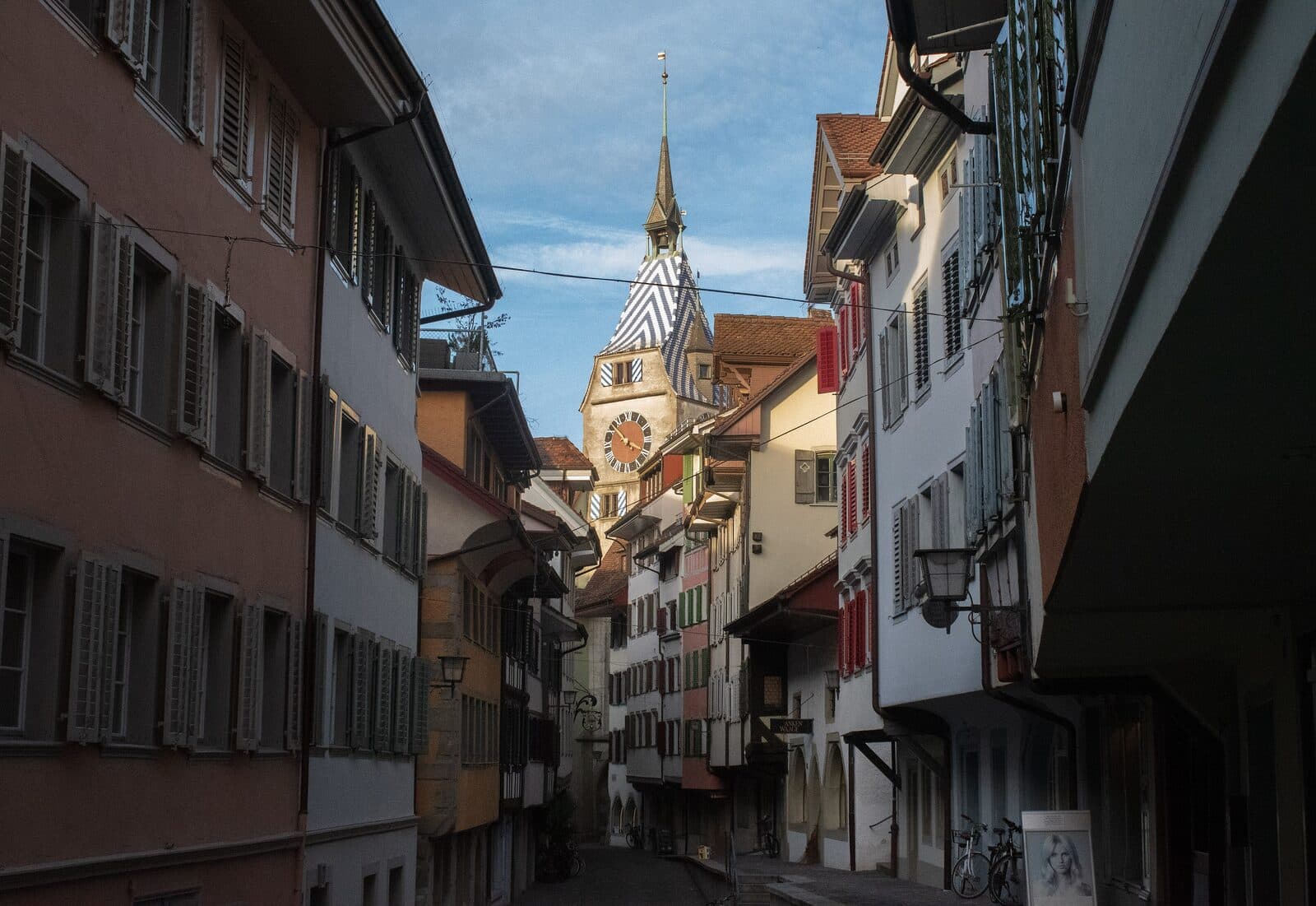
If you live in Zug, your permits go through the Migration Office of the Canton of Zug (Amt für Migration, AfM ZG), part of the cantonal Security Directorate. Zug applies federal immigration law like every other canton and works in German. What sets it apart is its economy: commodities trading, holding companies and the crypto cluster bring many highly qualified workers from outside the EU/EFTA, so the office handles a lot of skilled-worker B permits for its size.
In short
- Your office: the AfM ZG. Current address, phone and opening hours are on https://www.zg.ch/migration.
- Processing time: around four weeks for a simple, complete application; 4 to 10 weeks for a first B permit, 8 to 14 months for a hardship case.
- Language: German. Family reunification from a third country needs A1 spoken; early C needs B1 spoken and A1 written; naturalisation needs B1 spoken and A2 written.
- No voting rights for foreign nationals in Zug. Only naturalisation gives you a vote.
- Appeals: usually 30 days from the decision; the notice in your decision names the right body.
Zug at a glance
Zug is one of the smaller cantons by area and population, but it carries unusual economic weight. For years its share of foreign residents has been above the Swiss average, in the top third of cantons: well below Geneva, similar to Zurich. For current figures, see the Federal Statistical Office (FSO) and the cantonal statistical office.
Where Geneva is shaped by the UN and international organisations and Zurich by its financial centre, Zug is shaped by international commodities trading, the crypto and blockchain cluster known as Crypto Valley, and many holding companies and international firms. That draws highly qualified third-country nationals from banking, trading, tech and crypto, and EU/EFTA nationals in the same sectors.
Who lives here
- EU/EFTA nationals are the largest group, mainly from Germany, Italy, Portugal, France and Spain, and increasingly from Eastern Europe.
- Third-country communities include the United Kingdom (since Brexit), the USA, India and China, as well as Turkey, Kosovo, North Macedonia and Sri Lanka.
- B permits are the most common, with an above-average share of highly qualified workers admitted under Art. 18 FNIA. C permits come second.
- L permits are relatively common in trading and consulting. G permits exist but are much less common than in Geneva, Ticino or Basel-Stadt. Ci permits are few.
- F and N permits follow the allocation key of the State Secretariat for Migration (SEM) under Art. 27 AsylA.
Which law applies
Zug applies federal law first: the Federal Act on Foreign Nationals and Integration (FNIA, SR 142.20), the Ordinance on Admission, Residence and Gainful Employment (OASA, SR 142.201), the Agreement on the Free Movement of Persons (AFMP, SR 0.142.112.681), the Asylum Act (AsylA, SR 142.31), and SEM practice and directives. The glossaries explain these: FNIA and OASA, AFMP and the Asylum Act.
Cantonal law adds:
- the Introductory Act to the Lawyers Act (EG BGFA ZG, BGS 163.1) and the Ordinance on Lawyers (BGS 163.4), which implement the Federal Act on the Free Movement of Lawyers (LLCA, SR 935.61), including the bar register and the supervisory commission;
- the Administrative Procedure Act (VRG ZG), which governs procedure and appeals;
- cantonal implementing rules for the FNIA and the Asylum Act;
- the cantonal Citizenship Act for naturalisation.
Current versions are in the Zug legislative collection at https://bgs.zg.ch.
The Migration Office
The AfM ZG is much smaller than the offices in Geneva or Zurich. It handles:
- B permits for EU/EFTA and third-country nationals, L and C permits, renewals and changes of status;
- family reunification with Swiss citizens (Art. 42 FNIA ff.) and with B holders (Art. 44 FNIA);
- coordination of naturalisations;
- through its Returns Division (Measures), enforcement of removals in asylum cases. This division is not a general contact point for overstayers or for people removed under ordinary immigration law.
Contact details for each division are on https://www.zg.ch/migration.
How Zug applies the rules
Language
Zug requires standard German; Swiss German is not tested.
- Family reunification from a third country (B permit): German at A1 spoken, based on Art. 58a para. 1 let. c FNIA and Art. 77d OASA.
- Early C permit after five years (Art. 34 para. 4 FNIA with Art. 62 para. 1bis OASA): in practice B1 spoken and A1 written in German.
- Accepted proof: the fide certificate in German and the diplomas listed in Art. 77d OASA, such as telc, Goethe or ÖSD at the right level.
These are federal minimums and the office may apply them differently from case to case. Ask the AfM ZG for current requirements.
Integration agreements
Under Art. 58a and 58b FNIA, the canton can sign an integration agreement with a third-country national who has integration gaps, or issue an integration recommendation. Zug uses these rarely, unlike Vaud, which uses them systematically. An agreement usually comes up only when a renewal shows clear problems with language, work or public order.
Hardship cases
For hardship cases (Art. 30 para. 1 let. b FNIA), Zug sits in the middle: less open than Geneva, less strict than the more restrictive German-speaking cantons. The office decides at its discretion under the federal criteria in Art. 31 OASA: integration, family situation, finances, length of stay, health and the chance of reintegrating in your home country. The SEM must approve (Art. 99 FNIA), which can add a lot of time. For help building an application, see a lawyer on the Zug bar register.
Early C permit
An early C after five years instead of ten (Art. 34 para. 4 FNIA) needs successful integration and is at the office's discretion, not a right. Zug is neither especially strict nor especially generous. It looks at the higher language level (B1 spoken, A1 written), supporting yourself without social assistance, orderly finances and respect for public order. Grant rates are not published.
Family reunification
For family from third countries (Art. 43 to 47 FNIA), the AfM ZG checks all of these together: income, suitable housing, no reliance on social assistance, language and integration. Zug's housing market is one of the most expensive in Switzerland, which can matter when the office checks whether your home is suitable.
For children, the age limits and deadlines of Art. 47 para. 1 FNIA apply (with Art. 73 OASA). For late applications, the office checks for important family reasons (Art. 47 para. 4 FNIA), guided by Federal Supreme Court case law such as BGE 137 I 284.
Separation and divorce
If you separate from or divorce a Swiss citizen or a C holder, Art. 50 FNIA applies. You may keep your permit after a marriage of three years with integration (para. 1 let. a) or for important personal reasons such as domestic violence (para. 1 let. b). See separation and divorce (Art. 50 FNIA).
Highly qualified workers from third countries
Zug sees many third-country B applications for skilled workers under the admission rules for employment (Art. 18 to 25 FNIA), and the office is used to them. It checks:
- priority for workers from Switzerland and the EU/EFTA (Art. 21 FNIA);
- your personal qualifications (Art. 23 FNIA);
- salary and working conditions usual for the place, profession and sector (Art. 22 FNIA);
- the federal quotas (Art. 20 FNIA).
Questions about wording a job description or structuring a salary belong with your employer, HR or a specialised lawyer.
International organisations and the Ci permit
Zug has only a small international-organisation presence and no UN sites. The Federal Department of Foreign Affairs (FDFA) keeps the list of organisations with a headquarters agreement. International NGOs in climate, digital and standards work have added to this group, but it is nothing like Geneva.
The Ci permit is for accompanying family (spouses, minor children) of FDFA legitimation-card holders who want to work or train. It is based on the Host State Act (HSA, SR 192.12) and the Host State Ordinance (HSO, SR 192.121). The rules are the same as in Geneva; only the numbers are smaller. See the Ci permit.
How long it takes
These are rough guides, not guaranteed deadlines. The AfM ZG does not publish official processing times; only the office can tell you where your file stands.
| Procedure | Rough guide |
|---|---|
| First B permit (family reunification, work) | 4 to 10 weeks |
| B renewal | 2 to 6 weeks |
| Ordinary C (after 10 years) | 6 to 12 weeks |
| Early C (Art. 34 para. 4 FNIA, after 5 years) | 6 to 14 weeks |
| Family reunification (third country) | 8 to 16 weeks |
| Hardship case (Art. 30 para. 1 let. b FNIA) | 8 to 14 months |
| Naturalisation (municipality, canton, Confederation) | 18 to 30 months in total |
| Appeal to the Administrative Court | 6 to 18 months |
SEM approval (Art. 99 FNIA) is not included and can add weeks to months.
What slows things down: missing documents, SEM approval (Art. 85 para. 2 and Art. 86 OASA), language certificates sent after you apply, criminal-record checks from several countries, and the quota situation for skilled third-country workers. There is no formal fast track. A written enquiry once the usual time has passed, or explaining a real urgency, can help. As a last resort, and with a lawyer, you can appeal for delay or denial of justice to the Administrative Court under the VRG ZG.
Tax at source
Zug's cantonal and municipal taxes are low compared with other cantons; the Federal Tax Administration (FTA) and the cantonal tax administration publish comparisons. This has no effect on how your immigration application is assessed.
If you hold a B permit and no C permit, your employer usually deducts tax from your salary. This rests on the Federal Act on Direct Federal Taxation (DBG, SR 642.11) and the Tax Harmonisation Act (StHG, SR 642.14), with details in the federal withholding tax ordinance and the cantonal tax act.
- Above around CHF 120,000 gross a year: a subsequent ordinary assessment (NOV) is compulsory.
- Below that: the withholding tax is usually final, but you can request an ordinary assessment.
- When it ends: with a C permit or marriage to a Swiss citizen, you move to ordinary assessment.
Some cantons used to offer special tax deductions for foreign experts. These have been restricted and standardised in recent years; ask the cantonal tax administration what applies now.
Tax arrears or heavy debts do not on their own lead to revocation. They can count in the integration assessment and under public order and proportionality (Art. 96 FNIA). A revocation or refusal to renew needs a legal ground under Art. 62 FNIA and a weighing of interests.
Registering a home in Zug for tax reasons without really moving your life there can be treated as abuse, both in tax law and in immigration law (residence under Art. 23 and 24 CC and Federal Supreme Court case law). For tax questions, ask the Zug tax administration or a qualified tax adviser.
Naturalisation
The Confederation, the Canton of Zug (under the cantonal Citizenship Act) and your municipality all have to agree.
Federal rules. The Swiss Citizenship Act (SCA, SR 141.0), in force since 1 January 2018, requires as a rule ten years of residence in Switzerland (Art. 9 SCA), successful integration and suitability (Art. 11 SCA) and meeting the integration criteria (Art. 12 SCA). You must not endanger internal or external security. The separate Swiss Citizenship Ordinance (SCO, SR 141.01) sets the language level: B1 spoken and A2 written in a national language (Art. 6 SCO), in Zug German. See the 2018 Citizenship Act glossary.
Cantonal and municipal rules. You need several years of residence in the canton and in your municipality. The details differ between Zug's roughly eleven municipalities and are in their regulations. Most municipalities no longer hold a routine interview with a citizenship commission, though they can in a given case. The canton may require a knowledge test (history, geography, civics) and a criminal-record extract. Check the cantonal Citizenship Act on https://bgs.zg.ch and ask the cantonal naturalisation office and your municipality.
No voting rights for foreign nationals
Jura, Neuchâtel, Vaud, Fribourg and Geneva give foreign nationals some voting rights. Zug does not, at any level, even for long-term C holders. A cantonal initiative to introduce municipal voting rights was rejected at the ballot box. As in Zurich, naturalisation is the only way to gain a political vote. The State Chancellery and the Cantonal Council publish any new proposals.
Lawyers in Zug
Lawyers admitted in Zug are on the cantonal bar register kept at the High Court (Obergericht), under the LLCA, the EG BGFA ZG (BGS 163.1) and the Ordinance on Lawyers (BGS 163.4). The Supervisory Commission for Lawyers, based at the High Court, supervises them. It does not advise clients. Contact details are on https://www.zg.ch/behoerden/gerichte/obergericht. The Zug Bar Association is a private professional body; membership is voluntary.
Appealing against an AfM decision
A decision of the AfM ZG (refusal, revocation, removal, a negative hardship decision) can be challenged. The notice of rights in your decision tells you the correct body and deadline.
- First appeal: usually within 30 days of notification. Depending on the subject, an internal body such as the Security Directorate may come before the court (VRG ZG).
- Administrative Court of the Canton of Zug: against the Directorate's decision, or directly against the AfM decision where the law allows. The deadline is usually 30 days. The court reviews facts and law.
- Federal Administrative Court in St. Gallen: in some cases, in particular where the SEM decided at the lower level. The deadline is 30 days (Art. 50 of the Administrative Procedure Act, VwVG).
- Federal Supreme Court in Lausanne: an appeal in public-law matters against final cantonal judgments and Federal Administrative Court judgments (Art. 82 ff. of the Federal Supreme Court Act, BGG). Many immigration matters are excluded, in particular discretionary permits (Art. 83 BGG), so check carefully whether an appeal is possible.
For complex cases, work with a lawyer on the Zug bar register.
In a crisis
- 117: police emergency.
- 142: national emergency number for domestic violence (Victim Support Switzerland, www.opferhilfe-schweiz.ch).
- 143: Die Dargebotene Hand, confidential phone support in German, 24/7, free.
- 147: Pro Juventute, for children and young people, 24/7.
- Frauenhaus Zug (women's shelter): +41 41 727 76 86.
- Victim Support of the Canton of Zug: under the Victim Support Act (OHG, SR 312.5).
For how domestic violence affects your permit (Art. 50 para. 1 let. b and para. 2 FNIA), see separation and divorce and domestic violence.
Asylum in Zug
Zug has no federal asylum centre of its own. The first phase of the accelerated procedure (Art. 26b AsylA) takes place at the federal asylum centre with a procedural function of the Ticino and Central Switzerland asylum region, in Ticino, and other sites of that region. If your application moves to the extended procedure (Art. 26d AsylA), you are allocated to a canton under the SEM key, and Zug takes a share in line with its population.
The legal advice office for asylum seekers (RBS) for Zug is Caritas Central Switzerland, which covers Lucerne, Nidwalden, Obwalden, Schwyz, Uri and Zug. It provides the legal help foreseen in the extended procedure (Art. 102f AsylA) and wider advice on repeat applications and removals. Contact details: https://www.caritas-luzern.ch/was-wir-tun/rechtsberatung-fuer-asylsuchende. See the Asylum Act glossary.
Zug compared with Geneva and Zurich
- Profile: Zug is crypto, trading and holding companies with a focus on highly qualified workers; Zurich has a broad finance, research and tech base; Geneva is shaped by international organisations.
- Language: German in Zug and Zurich, French in Geneva.
- Hardship cases: Zug and Zurich in the middle, Geneva more open.
- Integration agreements: rare in Zug, selective in Zurich, moderate in Geneva, systematic in Vaud.
- Voting rights: none in Zug or Zurich; Geneva after eight years in Switzerland and three months in the municipality.
- Taxes: low in Zug, middle in Zurich, high in Geneva. This plays no part in immigration decisions.
This is not a reason to choose a canton. Where you live should follow your work, family and life. See Geneva, Zurich and the German-speaking standard-practice cantons.
Getting help
This page explains the law and practice. It is not individual legal advice. For a hardship case (Art. 30 FNIA, Art. 31 OASA), an appeal or another specific problem, contact a lawyer on the Zug bar register.