
If you live in Appenzell Ausserrhoden, your permits, renewals, family reunification and settlement applications go through the cantonal migration authority, and naturalisation goes through the Amt für Bürgerrecht und Zivilstand (the cantonal office for citizenship and civil status). The canton applies federal immigration law like every other canton, and the language for everything official is German. This page explains who to contact, how long things roughly take, what language level you need and how naturalisation works here.
In short
- Your office: the cantonal migration authority, part of the social or internal affairs administration. Find current contact details on https://www.ar.ch or in the SEM directory of cantonal migration offices.
- Processing time: around four weeks for basic processing. First B permits usually take longer, renewals are usually quicker.
- Language: German. Family reunification from a third country usually needs A1 spoken; an early C permit needs B1 spoken and A1 written, and naturalisation needs B1 spoken and A2 written.
- Naturalisation: the Confederation, the canton and your municipality all have to agree. In some municipalities the local assembly still takes part in the decision.
- Tax: without a C permit you are usually taxed at source; above roughly CHF 120,000 gross a year, you move to an ordinary assessment.
Appenzell Ausserrhoden at a glance
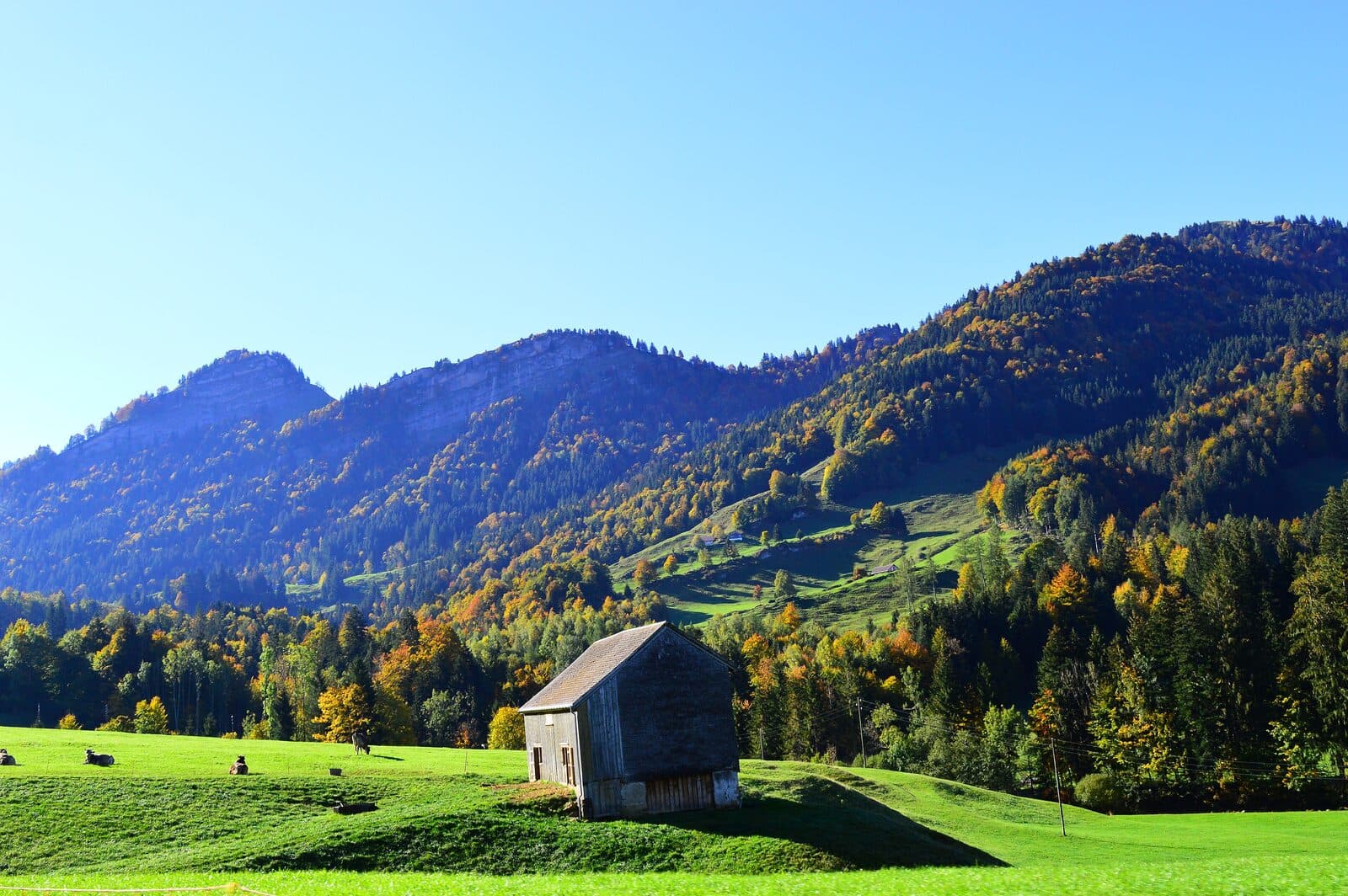
Appenzell Ausserrhoden (AR) is one of the two Appenzell half-cantons in north-eastern Switzerland. Its capital is Herisau. It is small in population and area, with hilly countryside, a history of textile work and an economy of small and medium-sized firms. Roughly one sixth of residents are foreign nationals; for exact and current figures, check the Federal Statistical Office (FSO) or www.ar.ch.
Official procedures are in German, written in standard German.
Which law applies
Immigration law is federal law, and the cantons apply it. Appenzell Ausserrhoden uses the same federal rules as everyone else:
- the Federal Act on Foreign Nationals and Integration (FNIA, SR 142.20): admission for work (Art. 18), study (Art. 27), hardship cases (Art. 30 para. 1 let. b), the B permit (Art. 33), the C permit (Art. 34), changing canton (Art. 37), family reunification (Art. 42 to 47), the end of a marriage or family union (Art. 50), integration (Art. 58a and 58b), revocation (Art. 62 and 63) and SEM approval (Art. 99);
- the Ordinance on Admission, Residence and Gainful Employment (OASA, SR 142.201), including Art. 31, Art. 60 para. 2, Art. 62 para. 1bis and Art. 77d (language proof) and Art. 85 and 86 (approval procedure);
- for EU/EFTA nationals, the Agreement on the Free Movement of Persons (AFMP, SR 0.142.112.681) and its implementing ordinance (OFMP);
- the Asylum Act (AsylA, SR 142.31);
- the Swiss Citizenship Act (SCA, SR 141.0) and the Swiss Citizenship Ordinance (SCO, SR 141.01) for naturalisation.
The canton adds its own implementing act for the FNIA, a cantonal citizenship act and administrative-procedure law, which set out who decides, the fees and the procedure. Check the current versions in the cantonal legislative collection. The glossaries explain the federal terms: FNIA and OASA, AFMP and OFMP and the Asylum Act.
Who to contact
The cantonal migration authority handles first applications, renewals, family reunification, changes of canton and settlement permits. For citizenship and civil status, the Amt für Bürgerrecht und Zivilstand is responsible.
- Cantonal website: https://www.ar.ch
- Citizenship and civil status: https://www.ar.ch/verwaltung/departement-volkswirtschaft-und-inneres/amt-fuer-buergerrecht-und-zivilstand/
- SEM directory of cantonal migration offices: https://www.sem.admin.ch/sem/de/home/sem/kontakt/kantonale_behoerden.html
Names, addresses, phone numbers, opening hours and online services in small administrations change, so check these pages for current details. The cantonal website also shows whether you can apply online.
How long it takes
No law fixes a processing time, and the figures below give you no right to a decision by a given date. They depend on how complete your file is and on follow-up questions.
| Procedure | Rough guide |
|---|---|
| Basic processing | around 4 weeks (confirm with the office) |
| First B application | usually longer |
| B renewal | usually shorter |
| C permit or family reunification | depends on your file and on any approval procedure |
If your application needs SEM approval (Art. 99 FNIA, with Art. 85 and 86 OASA), the time for the federal approval comes on top of the cantonal processing time.
Language requirements
The official language is German. Swiss German dialect is not required and is not tested in the fide system. Levels follow the Common European Framework of Reference for Languages (CEFR).
- Family reunification from a third country (B permit): usually German at A1 spoken (Art. 58a para. 1 let. c FNIA with Art. 77d OASA and the SEM directives). Ask the office how it applies this.
- Early C permit (Art. 34 para. 4 FNIA with Art. 62 para. 1bis and Art. 77d OASA): usually B1 spoken and A1 written in German. The same standard applies to EU/EFTA nationals seeking an early C.
- Accepted proof: the fide certificate in German, or an equivalent diploma listed in Art. 77d OASA, such as Goethe-Zertifikat, telc Deutsch or ÖSD.
See language proof (A1, A2, B1, fide).
B, L and C permits
Appenzell Ausserrhoden follows the federal rules and SEM directives. As far as is known, it has no special cantonal practice of its own. Because case numbers are small, individual handling matters a lot, but that says nothing about whether the canton is stricter or more lenient.
- B residence permit (Art. 33 FNIA): for work under Art. 18 FNIA (third-country nationals, subject to quotas and SEM approval under Art. 99 FNIA), for study under Art. 27 FNIA, and for EU/EFTA nationals under the AFMP and OFMP.
- L short-term permit: for temporary work and short stays under the OASA.
- C settlement permit (Art. 34 FNIA): as a rule after ten years (Art. 34 para. 2 FNIA, shorter for some nationalities), or after five years with successful integration and the required language level (Art. 34 para. 4 FNIA; Art. 62 para. 1bis OASA).
Naturalisation
Ordinary naturalisation has three levels: municipal citizenship, cantonal citizenship and the federal naturalisation authorisation from the SEM. All three must agree. The SCA and SCO apply, together with the cantonal citizenship act and municipal regulations.
- Residence: the federal minimum is set in Art. 9 SCA. The canton and your municipality set their own residence periods, which can differ.
- Language: B1 spoken and A2 written in German. This level is set in the ordinance, Art. 6 SCO, not in the act.
- Integration: the conditions are in Art. 11 SCA and the integration criteria in Art. 12 SCA: successful integration, familiarity with Swiss life and no threat to internal or external security.
- Your municipality: in some municipalities, voters or the municipal assembly take part in the decision. Ask your municipality how it works there. Any municipal hearing must respect the federal bans on discrimination.
The Amt für Bürgerrecht und Zivilstand handles the cantonal level. See naturalisation in Switzerland.
Asylum
The State Secretariat for Migration (SEM) runs asylum procedures in federal asylum centres (FAC). Appenzell Ausserrhoden is in the Eastern Switzerland asylum region; www.sem.admin.ch shows the FAC location. The SEM allocates asylum seekers to cantons by a distribution key (Art. 27 AsylA). After allocation, the canton provides housing and emergency aid.
In the accelerated procedure, free legal advice and representation come from an organisation mandated by the SEM (Art. 102f ff. AsylA). The SEM website names the current organisation for the region. See the Asylum Act glossary, the N permit, the F permit and S protection status.
Tax at source
- Withholding tax: if you hold a B permit, your employer usually deducts income tax from your salary. The canton levies this tax within the federal harmonisation framework (Tax Harmonisation Act, SR 642.14). The cantonal tax administration sets rates and procedure.
- Ordinary assessment: above a gross annual income usually given as around CHF 120,000, you move to a subsequent ordinary assessment. Check the exact threshold with the cantonal tax administration.
- Tax debts and your permit: unpaid taxes or debt enforcement do not on their own lead to revocation. Serious, culpable debt can still count against you in the integration assessment (Art. 58a FNIA) and under public security and order (Art. 62 and 63 FNIA). The authority looks at each case.
For tax questions, ask the cantonal tax administration or a tax adviser.
Municipalities and housing
The capital is Herisau. Other larger municipalities include Teufen, Speicher and Heiden; check the FSO or cantonal statistics for current population figures. Rents change quickly, so use the FSO rent statistics or cantonal and municipal information for current levels.
Getting legal help
This page explains the law and normal practice. It is not individual legal advice. For a hardship case (Art. 30 para. 1 let. b FNIA), family reunification (Art. 42 to 47 FNIA), a separation (Art. 50 FNIA) or an appeal, contact a lawyer registered with the cantonal bar. The Lawyers Act (LLCA, SR 935.61) governs who may give individual legal advice.
Related pages
- German-speaking standard-practice cantons, the group Appenzell Ausserrhoden belongs to
- B residence permit, C settlement permit, L short-term permit, G cross-border permit, Ci permit
- Changing canton (Art. 37 FNIA)
- Family reunification with a Swiss citizen
- Hardship cases (Art. 30 FNIA)
- Divorce and your permit (Art. 50 FNIA)
- Integration agreement (Art. 58b FNIA)