
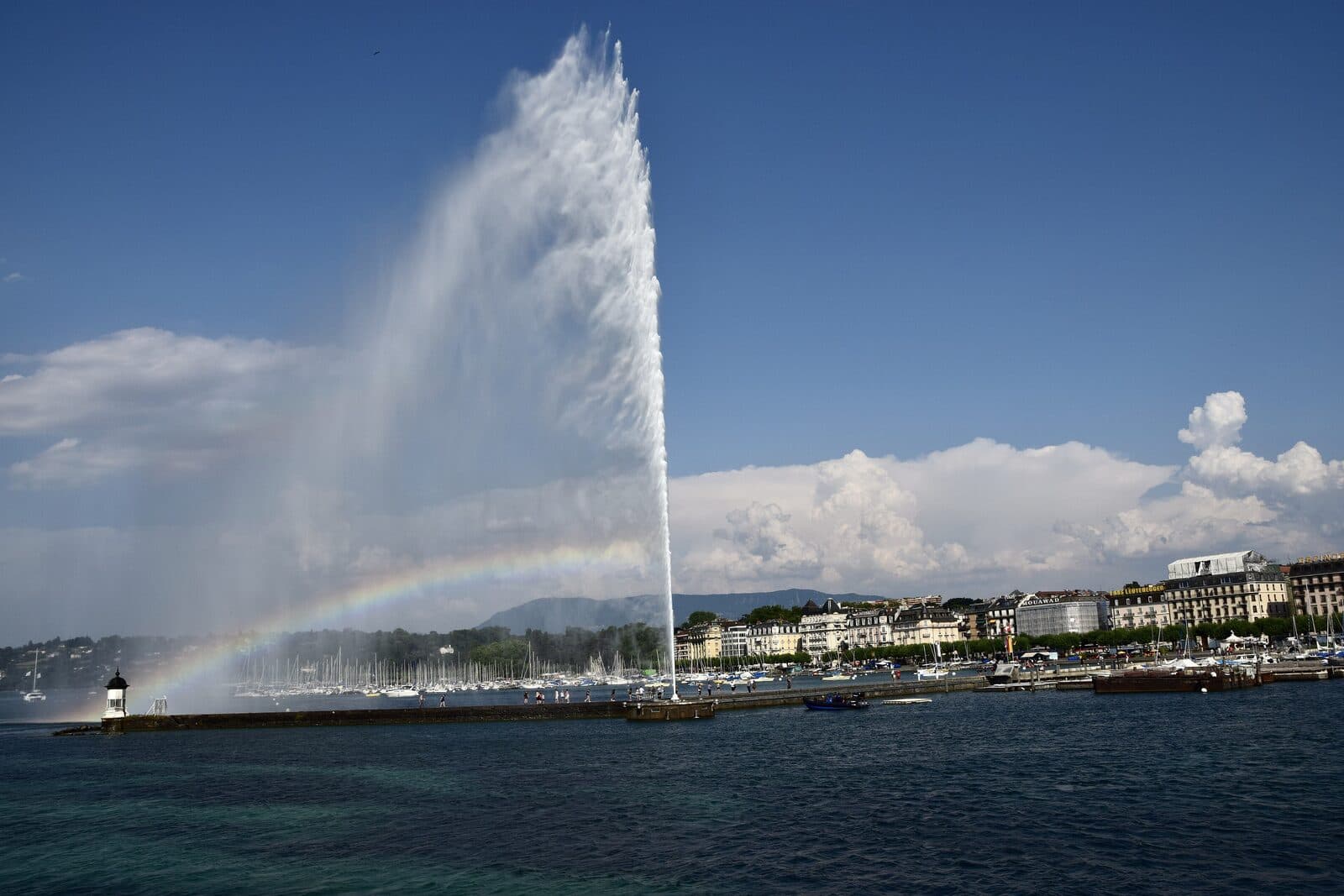
In Geneva, residence permits are handled by the Office cantonal de la population et des migrations (OCPM), the cantonal migration office. What sets Geneva apart is who lives there: around two fifths of residents are not Swiss, the canton hosts a large international organisation community, and over 110,000 cross-border commuters work there. Procedures are in French, standard applications take around ten weeks according to the canton, and foreign residents can vote in municipal affairs after a minimum period of residence.
In short
- Your office: the OCPM, for everyone except diplomatic and consular staff, who fall under the Federal Department of Foreign Affairs (FDFA). Contact details and the e-démarches online portal: https://www.ge.ch/organisation/office-cantonal-population-migrations-ocpm
- Language: French. Family reunification from a third country needs A1 (spoken); the early C permit, as a rule, B1 (spoken) and A1 (written).
- International organisations: staff hold an FDFA carte de légitimation, which is not an FNIA permit. Their working spouses and children get a Ci permit from the OCPM.
- Deadlines to appeal: usually 30 days at each step, from the OCPM to the cantonal courts.
- Municipal voting: foreign residents can vote at municipal level after a minimum period in Switzerland and the canton.
Who lives in Geneva
About half a million people live in Geneva, and around two fifths do not hold Swiss citizenship, well above the national average. This includes permanent residents on B, C and L permits and non-permanent residents: Ci permit holders, people in the asylum procedure, and diplomatic and international organisation (IO) staff with a carte de légitimation. For current figures, see the cantonal statistical office (OCSTAT) and the Federal Statistical Office (FSO).
Geneva is one of the world's main hosts of international organisations, including the UN Office at Geneva (UNOG), the WTO, the ICRC and the IFRC, the ITU, WIPO, the GAVI Alliance, the Global Fund to Fight AIDS, Tuberculosis and Malaria, the ILO, OHCHR, UNHCR, UNCTAD, the WHO (global headquarters), the WMO, the International Organization for Migration (IOM) and the International Trade Centre (ITC). Around 250 international NGOs are also based here. They do not have IO status, but their staff often need special visas or residence arrangements.
Three legal worlds side by side
- Diplomatic and IO staff: the FDFA issues a carte de légitimation under the Host State Act (HSA, SR 192.12), the Host State Ordinance (HSO, SR 192.121) and headquarters agreements. These people are not subject to the Federal Act on Foreign Nationals and Integration (FNIA, SR 142.20).
- Cantonal permits: Ci permits for family members, ordinary B and C permits for people who stay after an IO job ends, and B and C permits for everyone else. These fall under the FNIA and the OCPM.
- Cross-border commuters: G permit holders who live in France (Pays de Gex, Haute-Savoie) or in Vaud and work in Geneva. EU/EFTA nationals fall under the Agreement on the Free Movement of Persons (AFMP, SR 0.142.112.681), third-country nationals under the FNIA. Quarterly figures are in the FSO cross-border commuter statistics (STAF).
A single family can hold several statuses at once: one parent on a carte de légitimation, the spouse on a Ci permit, the children on cartes de légitimation, and an adult child who starts work on a B permit after studying.
How the OCPM is organised
The OCPM is divided into sections. Sending your application to the right one saves time:
- Section Étrangers: the largest section. B, C, L and G permits, renewals, changes of status and family reunification.
- Section Organisations internationales: Ci permits, the switch from a carte de légitimation to an ordinary permit when an IO job ends, and other IO-related stays. Only Geneva has this section.
- Section Asile: asylum and removal under the Asylum Act (AsylA, SR 142.31), and coordination with the federal asylum centres.
- Section Naturalisation: cantonal and municipal naturalisation under the Swiss Citizenship Act (SCA, SR 141.0), cantonal law and municipal rules.
- Section Régularisation: hardship applications under Art. 30 para. 1 let. b FNIA from people without regular status (sans-papiers), and the legacy of Operation Papyrus (2017 to 2018).
The organisation can change after restructuring, so check the OCPM page.
Contact and online services
The OCPM's address, phone numbers, email addresses by section, counter hours and public transport links change regularly. Always check the official page listed above. The e-démarches portal lets you start many steps online, such as renewals, address changes and some first applications, and more are being added.
How Geneva applies the rules
Language
For a B permit through family reunification from a third country, and for some renewals, Geneva requires French at level A1 (spoken) on the Common European Framework of Reference. For the early C permit after five years instead of ten (Art. 34 para. 4 FNIA with the language rules of the OASA, SR 142.201), the federal minimum is as a rule B1 (spoken) and A1 (written) in French. Meeting these levels does not guarantee the permit: the authority has discretion and checks the other integration criteria too.
The fide certificate in French is accepted, as are the diplomas and certificates listed in the OASA. Cantonal practice can be stricter or more lenient than the federal minimum on some points, and SEM directives have been updated since January 2024, so check what you need with the OCPM before applying.
Integration agreement
Under Art. 58b FNIA, the canton can sign an integration agreement (convention d'intégration) with third-country nationals who have integration gaps. Geneva uses it less systematically than Vaud, typically when a renewal reveals gaps in language, work or respect for public security and order.
Hardship cases
Geneva's hardship practice is often described as relatively accessible, but that gives you no right and no guarantee. The OCPM assesses each case under Art. 31 OASA, looking at integration, family situation, finances, length of stay, health and your chances of reintegrating in your home country. A positive decision also needs SEM approval (Art. 99 FNIA).
Early C permit
The C permit after five years instead of ten (Art. 34 para. 4 FNIA) requires successful integration and is at the canton's discretion; there is no right to it. Geneva is generally described as cautious, but no reliable grant rate is published. The key factors are the higher language level, financial independence without social assistance, and respect for public security and order. Debts are not a separate ground for refusal but part of the overall integration assessment, depending on their size, cause and how you are repaying them.
Family reunification
For family members from third countries (Art. 43 to 47 FNIA), the OCPM checks that you have enough stable income, suitable housing, no reliance on social assistance and the required language skills. It applies the federal standards and, when judging housing, takes account of Geneva's very expensive housing market. That does not make it more generous: each case is assessed individually.
Children can join you until age 12, with a deadline of five years from when the right arose; for children over 12, the deadline is twelve months (Art. 47 para. 1 FNIA with Art. 73 OASA). For late applications, the OCPM checks whether there are important family reasons (Art. 47 para. 4 FNIA), following Federal Supreme Court case law such as BGE 137 I 284.
Separation and divorce
If you separate from or divorce a Swiss citizen or a C permit holder, Art. 50 FNIA applies. You can keep your permit after a marriage of at least three years if you are well integrated (Art. 50 para. 1 let. a FNIA), or for important personal reasons such as domestic violence (Art. 50 para. 1 let. b FNIA). The cantonal Section LAVI coordinates support for victims of domestic violence with the immigration assessment. See divorce and residence permit (Art. 50 FNIA).
The Ci permit and international organisations
A Ci permit is for family members, meaning spouses and minor children, of people with an FDFA carte de légitimation, when they want to work or train in Switzerland. It is based on the HSA and the HSO.
Do not confuse the two documents:
- The carte de légitimation is issued by the FDFA to the IO employee (official, delegate, contract staff) and their family. It rests on the privileges and immunities of international law, including the Vienna Convention, and the HSA. It is not an FNIA residence permit.
- The Ci permit is a cantonal residence permit under the FNIA and OASA that lets family members work or train. The OCPM's Section Organisations internationales issues it.
The difference matters for tax, social insurance, family reunification and your path to settlement. See the Ci permit for accompanying persons of IO staff.
When the IO job ends
When the IO employee retires, their contract ends or they leave the IO world, the carte de légitimation lapses, and the Ci permit falls with it. You must then apply quickly to convert to an ordinary permit, usually a B. A deadline of around 90 days is often mentioned, but the exact deadline depends on your situation, so check with the Section Organisations internationales or the FDFA in advance.
Many families in this situation have lived in Geneva for ten, fifteen or more years, with children in school or already naturalised. A hardship application under Art. 30 para. 1 let. b FNIA often comes into play, and Geneva typically gives weight to long integration, though always case by case.
Sans-papiers and Operation Papyrus
From February 2017 to December 2018, Geneva and the SEM ran Operation Papyrus, a controlled regularisation of long-term, integrated sans-papiers. The criteria included at least five years in Switzerland for families or ten years for single people, financial independence, no criminal record, enough French, and children integrated in school. Around 2,390 people were regularised.
Papyrus was a one-off. Sans-papiers now apply individually through the ordinary hardship procedure (Art. 30 para. 1 let. b FNIA with Art. 31 OASA). The Papyrus criteria still have some indirect influence but are not binding. For advice, contact the Centre de contact Suisses-Immigrés (CCSI) or the Collectif de soutien aux sans-papiers de Genève.
Asylum
Western Switzerland's federal asylum centre region has sites in Boudry (NE), Vallorbe (VD) and Geneva, including the centre at Geneva Airport for applications made on arrival. The preparatory phase is governed by Art. 26b AsylA and the accelerated procedure, carried out in the federal centre, by Art. 26c AsylA.
If your case moves to the extended procedure (Art. 26d AsylA), the SEM allocates you to a canton by its distribution key (Art. 27 AsylA). Geneva takes a share in line with its population. You then live and register in the canton, and legal representation usually passes from the federal service to a cantonal legal advice office.
Free advice and legal representation are governed by Art. 102f AsylA and following. In Geneva, they include CSP Genève (Centre social protestant, part of the Swiss Refugee Council network), ELISA-Asile and Caritas Genève. For a full, current list, ask the Swiss Refugee Council (OSAR) or the SEM. See the glossary on the Asylum Act.
Processing times
These are rough guides based on experience, not guaranteed deadlines. According to the canton, standard applications take around ten weeks.
| Procedure | Guide time |
|---|---|
| First B permit (family reunification, work) | 4 to 12 weeks |
| B permit renewal | 2 to 6 weeks |
| Ordinary C permit (after 10 years) | 4 to 12 weeks |
| Family reunification (third country) | 8 to 16 weeks |
| Hardship case (Art. 30 para. 1 let. b FNIA) | 6 to 12 months |
| Naturalisation (municipal, cantonal and federal) | 18 to 36 months in total |
| Appeal to the TAPI | 6 to 18 months |
SEM approval (Art. 99 FNIA) is not included and can add weeks to months.
What slows things down
- Missing documents: the OCPM will ask for more, which costs several weeks each time.
- SEM approval: needed in some cases (Art. 85 para. 2 and Art. 86 OASA; Art. 99 FNIA).
- Late language certificates: your case effectively waits until you send them.
- Security and criminal record checks: if you have lived in several countries or need records from abroad, this can add months.
- IO cases: these often need coordination with the FDFA Permanent Mission.
There is no formal fast track. In justified cases you can write to ask about progress once the guide time has passed, or point out genuine urgency, such as a job start date in your contract or a child's school enrolment. As a last resort, you can appeal to the TAPI for denial of justice or unjustified delay under the Geneva Administrative Procedure Act (LPA-GE), ideally with a lawyer.
Tips for your application
- Send a complete file. Typically: a colour copy of your passport, proof of address, language certificate, criminal record extracts from your country of residence and every country you lived in over the last ten years, proof of income and, if relevant, your employment contract. A complete file can save several weeks.
- Translations and apostilles. Foreign-language documents usually need a certified translation into French or German and, where required, an apostille under the Hague Apostille Convention. Requirements depend on the issuing country.
- Use e-démarches if you already have valid Geneva registration details; it is often faster than post.
- Report moves within 14 days. A move within Geneva goes to your municipality's population office, which informs the OCPM. If you move from another canton, you must register in your Geneva municipality within 14 days.
- Report a new passport. If you renew your passport while holding a B, C, Ci or L permit, tell the OCPM so it can update your foreigner identity card. You do not need a new permit.
Municipal voting rights
Under the Geneva constitution (Cst-GE), foreign residents can vote and take part in elections at municipal level, electing the Conseil municipal and voting on municipal matters, once they have lived in Switzerland and the canton for a minimum period. Check the Cst-GE and implementing rules for the exact conditions. This right dates from a 2005 constitutional revision. Standing for election, and cantonal and federal voting, remain reserved for Swiss citizens. Similar rules exist in Jura, Neuchâtel, Vaud and Fribourg.
Tax
Geneva's tax burden is generally described as above average; for figures, ask a tax adviser or the cantonal tax administration.
- Tax at source: if you work without a C permit, for example as a third-country national on a B permit, tax is usually deducted from your salary at source (impôt à la source). It is a cantonal tax, harmonised by the Tax Harmonisation Act (THA, SR 642.14) and applied under Geneva tax law. Above a gross annual income of CHF 120,000, an ordinary assessment follows automatically; below that, the deduction is normally final, but you can apply for an ordinary assessment.
- IO staff: holders of a carte de légitimation working for an IO are usually exempt from federal, cantonal and municipal tax on their IO salary, under the headquarters agreement and the HSA. Other income, such as rent, investments or non-IO work, can be taxable.
- Ci family members: a common mistake. The Ci holder's own earnings are taxed normally in Geneva, at source or by ordinary assessment. The IO employee's exemption does not extend to them.
- Cross-border commuters from France fall under the agreement of 11 April 1983 between Switzerland and France on taxing cross-border commuters' earnings: Geneva pays part of the tax it collects to France. Commuters from other EU states fall under the relevant double taxation agreements.
For tax questions, ask the Administration fiscale cantonale (AFC) Genève, via www.ge.ch, or a qualified tax adviser.
The G cross-border permit
Over 110,000 cross-border commuters work in Geneva, mostly from the Département de l'Ain (Pays de Gex) and Haute-Savoie, and some from Vaud.
- Legal basis: the AFMP for EU/EFTA nationals; Art. 35 FNIA for third-country nationals, who must also hold a permanent right of residence in the neighbouring country and have lived in its border zone for at least six months (Art. 35 para. 1 FNIA).
- Processing: the Section Étrangers handles G applications. With a complete file, EU/EFTA applicants usually get the permit within two to four weeks.
- Validity: as a rule for the length of your employment contract; for a permanent contract, five years, then renewal.
- Returning home: you can return home daily, or stay in Switzerland during the week and return at least once a week. If you stay during the week, check registration and tax rules with the OCPM and the cantonal tax administration.
Naturalisation
You need approval at three levels: the federal naturalisation authorisation (under the SCA and the Citizenship Ordinance, SCO, SR 141.01), Geneva cantonal citizenship, and citizenship of your municipality.
- Language: Art. 12 para. 1 let. c SCA requires sufficient language skills as an integration criterion. Art. 6 SCO sets the level: B1 (spoken) and A2 (written) in a national language, which in Geneva is French. The fide certificate and the equivalent diplomas listed in the SCO are accepted.
- Municipal hearing: before the revised SCA came into force on 1 January 2018, many Geneva municipalities held a hearing (audition communale) before a citizenship commission. It is no longer a standard step, but some municipalities may still hold one. Ask your municipality.
- Civic knowledge test: the canton may require a test de connaissances civiques on Swiss, cantonal and municipal institutions, history and geography. It is set out in the cantonal citizenship act (Loi sur la nationalité genevoise, LNat); check the current rules with the Section Naturalisation.
See the glossary on the Citizenship Act 2018.
Geneva laws you will come across
- LaLEtr (RSG F 2 10): the cantonal law implementing the FNIA, including responsibilities, procedure and the integration agreement.
- LIASI (RSG J 4 04): the cantonal social assistance law. Receiving social assistance can affect renewals, revocations and naturalisation.
- LNat: the cantonal citizenship law.
- LPAv (RSG E 6 10): the cantonal law on the legal profession.
Current versions are on silgeneve.ch.
Appealing an OCPM decision
A refusal, revocation or removal decision from the OCPM can be challenged in stages. The decision itself tells you which remedy applies and the deadline.
- Réclamation to the OCPM, for some types of procedure, usually within 30 days of notification. When this step applies follows from the LaLEtr and the LPA-GE.
- Appeal to the Tribunal administratif de première instance (TAPI), within 30 days under the LPA-GE.
- Appeal to the Chambre administrative de la Cour de Justice, again within 30 days.
- Appeal to the Federal Supreme Court in Lausanne, in the cases allowed by the Federal Supreme Court Act (SR 173.110, Art. 82). In immigration and asylum law this is often excluded, leaving only a subsidiary constitutional appeal. Check admissibility for your case.
Finding a lawyer
Lawyers admitted in Geneva are listed in the Tableau des avocats, kept by the Commission du barreau. It is the cantonal supervisory authority and handles discipline, under the LPAv and the Lawyers Act (LLCA, SR 935.61), including the professional rules in Art. 12 LLCA. Its contact details are on justice.ge.ch. The Ordre des avocats de Genève (ODAGE) is a private professional association; membership is voluntary but common.
Help in a crisis
- 142: national domestic violence helpline, around the clock, in German, French and Italian. In Geneva it works with the Section LAVI (victim support).
- 143: La Main tendue, around the clock, with a French-language line for Geneva.
- 147: Pro Juventute, for children and young people, around the clock.
- OCPM Section Régularisation: questions about sans-papiers status, during office hours.
- CCSI, the Collectif sans-papiers Genève and CSP Genève: social, asylum and immigration advice.